
Accessing a GP - Information & Support
Seeing your GP can be an important first step if you are struggling with your mental health. We hope the information here helps you feel a little more prepared.
Your GP can help you to work out the care and treatment that will be best for you, and may refer you to specialist services for additional support. Visiting a GP can feel overwhelming particularly when you are neurodivergent.
1. Why accessing a GP can be hard
Just as a step at the entrance of a surgery would create a barrier for a wheelchair user, being neurodivergent can mean we face barriers to both getting through the door and being given the right support once we are there.
The sensory environment: lighting, sounds or smells that feel uncomfortable
Waiting in a busy, unfamiliar environment
Making an appointment, or getting there on time
Not knowing what to expect
Finding it hard to express feelings or experiences
Past experiences of not being listened to
Concerns about being judged or misunderstood
"It takes so much effort to get to the point of being there and asking for the thing you need. Then, they didn't listen. This has stopped me going back."
For many of us it's a combination of several of these. Any one of them can be enough to prevent us accessing the care we need.
You have a legal right to equal access Under the Equality Act 2010, your GP practice has a legal duty to make sure neurodivergent people can access care as easily as anyone else. The information below can help you use that right.
2. Preparing for your appointment
Visiting the GP involves a lot of unknowns — unfamiliar environments, unexpected questions, and interactions with people you may not have met before. Taking a few steps to prepare can reduce anxiety and help you feel more able to cope.
Understanding what to expect
Look up your GP surgery's website — you may find information about how appointments work and who you will meet
Contact the surgery to ask for information in advance — this is a reasonable adjustment they should provide
Ask to visit the surgery before your appointment — to familiarise yourself with the environment.

Planning what to say
It's not easy to share very personal thoughts and feelings with someone — especially under pressure. Taking time to think over what you want to say, and writing things down, can help you feel more prepared and make sure your GP gets the full picture.
"The hardest thing about going to the doctor is making yourself vulnerable in order to ask for help."
Writing things down also gives you the option of showing your notes to the GP directly, rather than having to say everything out loud in the moment.
Resources
Mind: what to say (video).
A short film to help you prepare for what to say to your GP.
Young Minds: speaking to your GP.
(For children and young people) . information on speaking to your GP about your mental health.
Childline: visiting your doctor.
For children and young people). Answers to common questions about visiting your GP. Written for children and young people.
NHS: how to register with a GP surgery.
This explains how to do it, including how to arrange an urgent appointment if you are not registered.
Keeping track of your symptoms
Keeping a record of your feelings and symptoms over time can provide really useful information for your GP. A mood diary or mood tracker can help with this.
My Possible Self — An NHS-approved mental health app that prompts you to track your mood each day and notice patterns over time.
Leeds Autism AIM — health resources — Resources to help you record and communicate your health needs, co-produced with autistic adults.
Mind — 'Find the Words' booklet — A booklet you can fill in before your appointment and take with you.
Doc Ready — Digital tools to help you communicate with your GP about your mental health. Build a checklist of your symptoms to print and bring.
NHS — preparing for your appointment — Helpful tips on what to think about before you go, and questions to ask your doctor.
Resources
Mind: taking the first steps.
Information on visiting the GP to talk about your mental health, including what to expect.
3. Giving your GP the full picture
It will help your GP to have a full understanding of your symptoms and experiences, and how these affect your life and change over time. Here are some examples of what may be useful to share.
Your symptoms
Feelings, thoughts, mood, worries, sleep, appetite, self-harm
"I feel like life is too hard"
"I have thoughts that upset me that I can't stop thinking about"
"I hurt myself sometimes on purpose"
How your symptoms change?
Do things get worse at certain times of day, in certain places, or around certain things?
"I feel anxious all the time, but it's worse when I am on my own"
"There are times when I feel suicidal, but I can be fine for a few weeks and then get really low"
How your symptoms affect your daily life?
Things you can't do, places you can't go, things you've stopped enjoying
"I feel so tired all the time — I'm finding it hard to get up for work"
"I used to like seeing my friends, but now I just make excuses and stay home"
Your background and history
Any diagnoses, medication, recent changes, or difficult experiences
"I was diagnosed as autistic when I was in primary school"
"A close friend died last year"
"I was bullied badly when I was younger"
4. Reasonable adjustments
Your legal right Under the Equality Act 2010, your GP practice has a legal duty to make sure neurodivergent people can access care as easily as anyone else. You may not see yourself as disabled — but the legal definition under the Equality Act includes being neurodivergent.
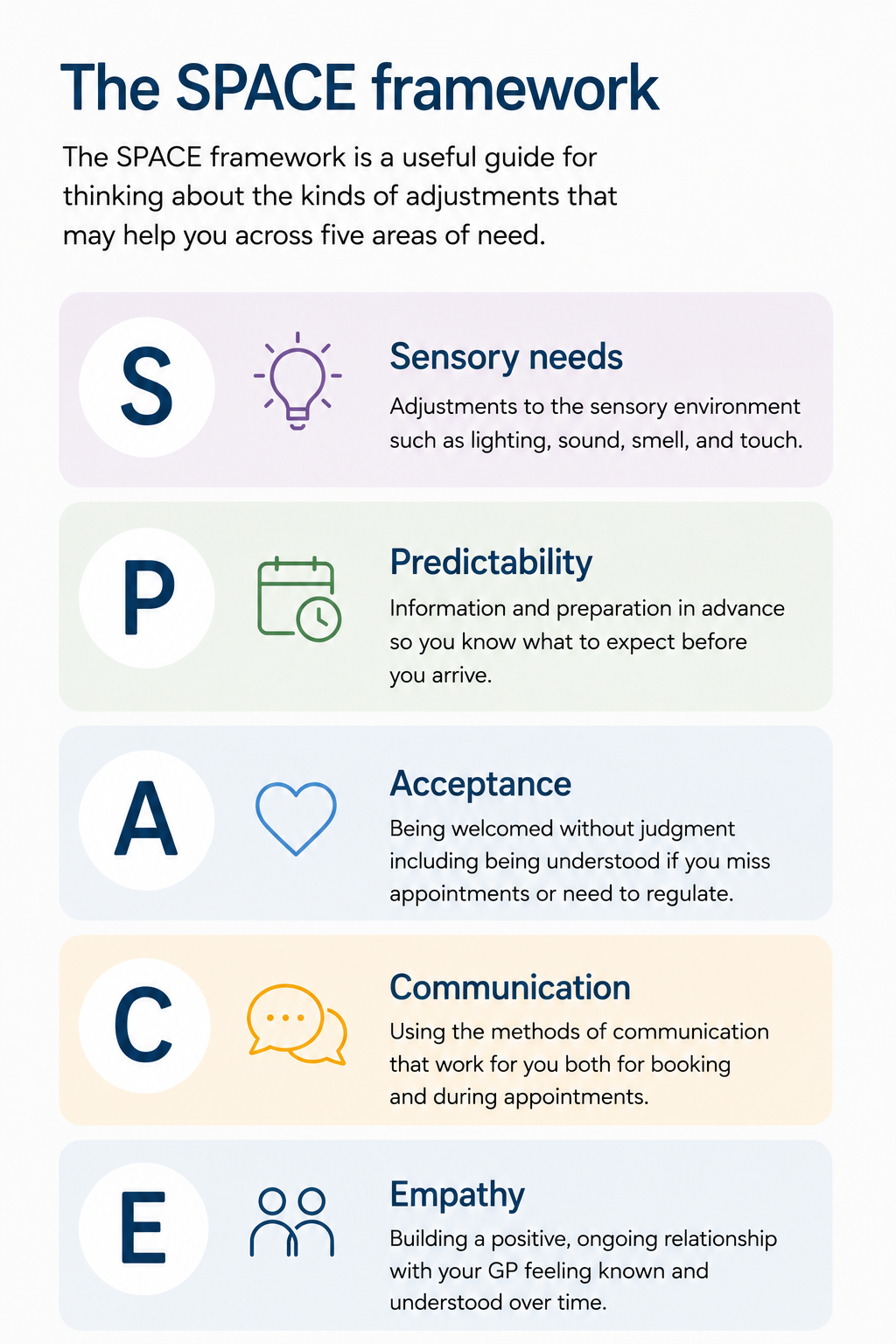
Reasonable adjustments are changes your GP practice can make to remove the barriers you face. What counts as a reasonable adjustment will depend on factors specific to each surgery — such as their staffing, resources, and building. Where an adjustment is possible and reasonable for them to make, they should do so. You can ask by phone, email, or in person — whichever works best for you.
Work out which adjustments to ask for.
Our reasonable adjustments tool helps you identify what would help across each area of need, and generates a letter you can send directly to your GP surgery.
5. Taking someone with you
You may find it helpful to take someone with you to your appointment. This person could help by:
Supporting your communication
Helping you to advocate for your needs
Keeping a record of important information
Offering emotional support to help you feel less anxious
Someone you trust
This could be a family member, friend, loved one, or support worker. Try to choose someone who will make sure you are listened to — not someone who will speak over you or on your behalf.
Let your GP surgery know in advance that someone will be accompanying you
Support from a local service
In some areas, specialist services may be able to arrange for someone to accompany you. This includes the Community Learning Disability Team, Learning Disability and Autism Liaison Teams, independent advocacy services, and local charities.
What's available varies by region and depends on your diagnosis and support needs. Ask your GP directly whether they can help arrange this.
[Guide to finding local services that can support you →]
6. Sharing information with healthcare staff
For many of us, our ability to communicate and express our needs is affected by the environment we are in, and struggling with poor mental health can affect this further. Having important information written down in advance means you don't have to rely on being able to explain everything in the moment. The NHS has developed two key ways to do this.
Healthcare passports
A healthcare passport is a document you fill in at home — by yourself or with support — and bring with you to appointments. You can hand it to any member of staff so they can immediately understand your needs and preferences.
A healthcare passport can include
Your general health
Your communication preferences
Your sensory needs
How you experience or show pain
The reasonable adjustments that will support you
Healthcare passports go by different names in different parts of the UK — you may also see them called a health passport, hospital passport, communication passport, or health and care passport. If yours says "hospital passport", this doesn't mean it can only be used in hospital — you can share it with any healthcare staff, including your GP.
Finding a healthcare passport
Ask your GP surgery whether they have one available for patients to fill in
Search online for "healthcare passport" or "hospital passport" together with the name of your area — for example, "healthcare passport hertfordshire"
Your Summary Care Record
If you are registered with a GP, you already have a Summary Care Record — unless you have chosen to opt out. This is a digital record that health and care staff can access when providing your care.
Your Summary Care Record includes
Your GP details and NHS number
Any health conditions you have
Any medications you take
Any allergies you have
Your Summary Care Record will also include Additional Information by default for most people — unless you have previously opted out. This can include details about long-term conditions, significant medical history, and specific communication needs. You can ask your GP surgery to review what Additional Information is included, and to add anything that will help staff to support you better — such as your communication preferences, any sensory needs or triggers, and the reasonable adjustments you need. Staff will be able to see this before and during your appointment, without you needing to explain it each time.
This is especially useful if you ever need support from emergency services, urgent care, outpatient clinics, or pharmacies — staff can access the information they need straight away.
Your information is protected Health and care staff will always ask your permission before viewing your Summary Care Record — except in a medical emergency where you are unable to give permission.
To review or add to your Additional Information, contact your GP surgery and ask them to go through the process with you.
NHS — Easy Read guide to adding additional information to your Summary Care Record — A visual, accessible guide produced by the NHS.
If the local healthcare passport version doesn't feel right for you
Our template — sharing information important for your healthcare — A template we have produced that you can fill in and bring to any healthcare appointment.
Leeds Autism AIM — Autism Health Passport — Co-produced with autistic adults. Includes a section specifically designed for use when accessing your GP surgery.