Making visiting a GP less of a challenge
Seeing your GP can be an important first step if you are struggling with your mental health. We hope the information here helps you feel a little more confident and prepared.
Visiting a GP can feel overwhelming particularly when you are neurodivergent. Your GP can help you to work out the care and treatment that will be best for you. They may refer you to specialist services for additional support.
Just as physical barriers can prevent some people accessing healthcare, neurodivergent people can face barriers to accessing healthcare and receiving the right support.
Some barriers that may effect you visiting your GP:
The sensory environment: lighting, sounds or smells that feel uncomfortable.
Waiting in a busy, rushed and unfamiliar environment.
Making an appointment over the phone.
Getting there on time.
Not knowing what to expect.
Finding it hard to express feelings or experiences.
Past experiences of not being listened to.
Concerns about being judged or misunderstood.
"It takes so much effort to get to the point of being there and asking for what you need. Then, they didn't listen. This has stopped me going back."
For many of us it's a combination of several of these. Any one of them can be enough to prevent us accessing the care we need.
Under theEquality Act 2010, your GP practice has a legal duty to make reasonable adjustments so neurodivergent people are able to access healthcare and receive appropriate support. The information below explains your rights and how to use them.
Visiting a GP can be hard

Reasonable adjustments
Your legal rights
Under the Equality Act 2010, your GP practice has a legal duty to make sure neurodivergent people can access care as easily as anyone else. You may not think of yourself as disabled, but the Equality Act's legal definition of disability includes neurodivergent people.
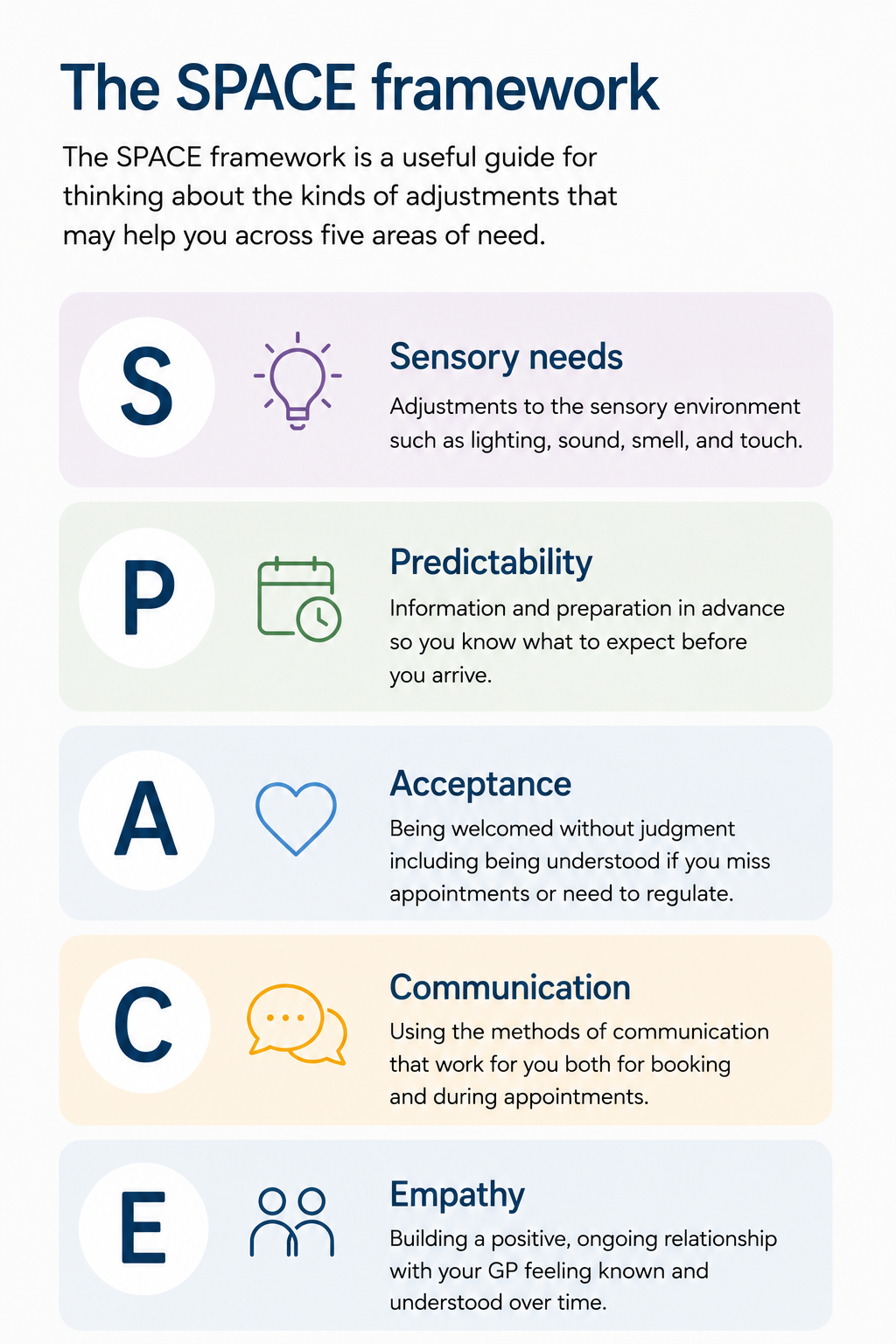
Reasonable adjustments are changes your GP practice can make to remove the barriers you face. What counts as a reasonable adjustment will depend on factors specific to each surgery such as their staffing, resources, and building. Where an adjustment is possible and reasonable for them to make, they should do so. You can ask by phone, email, or in person whichever works best for you.
Work out which adjustments to ask for.
Our reasonable adjustments tool helps you identify the adjustments that would improve your access to care and generates a letter you can send to your GP practice.